Work

I turn complex products into stories people act on.

Seven years of product marketing, mostly in edtech, building the function from zero. This is my professional work, and the rest of me, in one place.

I am Rimpi, a product marketer who starts with who is actually deciding and what they believe today, then uses behavioural science to find where the message breaks. I built the PMM function at Teachmint and launched Teachmint X, an AI powered B2B SaaS product that became the company's sole revenue driver in FY25. I took TUMO into India with 400+ admissions and zero paid acquisition, and grew Unacademy's SSC and Bank Exams channel past 1M subscribers.

Right now I am on a strategic sabbatical, building independent work and sharpening my craft for senior product marketing roles in AI, B2B SaaS and healthtech.

Rimpi Malik

How I think

Four things I always start with.

First

Who's actually deciding

Identify the real buyer and what they're afraid of getting wrong, not just the end user.

Second

What they believe today

Positioning is a correction to an existing belief, not a blank page.

Third

Where the friction is

Behavioural science finds where messaging breaks, before a customer tells you.

Fourth

What sales actually needs

Enablement that survives a real sales call, not just a deck reviewed in a meeting.

Journey

Where I have worked.

Five roles, five phases, newest first. Where there is a case study, it opens right under the role it came from.

Phase 05Apr 2025 to Feb 2026

Shikha Institute (TUMO Mumbai)

International Market Entry & Founding PMM

400+ admissions90%+ conversionZero paid acquisition

Led market entry for a global creative tech education network, launching India's first centre offering free digital training to 1,500 teenagers a year.

Read the case study

Launching an unknown international brand with zero paid acquisition

I led India market entry for TUMO, Armenia's creative tech education network, building an admissions pipeline from scratch in a market where nobody had heard of the brand.

Role

As Founding Product Marketer, I led India market entry for TUMO at Shikha Institute, launching the country's first centre offering free digital training to teenagers across robotics, AI, game development, and filmmaking.

Challenge

TUMO had zero brand awareness in India. The programme is free to attend, which removes the usual price objection but replaces it with a trust objection: why would a free, unknown programme be worth a teenager's time. There was no existing playbook for building credibility and an admissions pipeline in this market from nothing.

Approach

Built referral and outreach programmes designed as a low cost, repeatable model rather than relying on paid acquisition, and owned the full admissions pipeline personally. Supported an institutional partnership with the Nagaland Chief Minister and Education Ministry, which extended the model into Mission SOAR, a government initiative to transform school outcomes at scale.

Sample

ArtifactTransferable skill
Referral and outreach programme designZero budget growth, community led acquisition
Admissions pipeline ownershipFunnel management, conversion optimisation
Institutional partnership supportStakeholder management, government and B2G positioning

Impact

400+ admissions at 90%+ walkout to admission conversion, with zero paid acquisition, training 1,500 teenagers annually. The partnership contributed to Mission SOAR, a government initiative targeting 1,900+ schools.
Phase 04May 2021 to Mar 2025

Teachmint

0-to-1 GTM & AI Product Marketing Lead

₹81.5 Cr revenue10,250+ units sold30,000+ active usersSole revenue driver, FY25

Built the PMM function from zero. Launched Teachmint X, a net new AI powered B2B SaaS product, across hardware and software.

Read the case study

Building PMM across a company's entire product evolution

I owned product marketing across all three phases of Teachmint's evolution, mobile SaaS to B2B SaaS to hardware and software. The product I helped launch became the company's sole revenue driver in FY25.

Role

I joined Teachmint as a Product Marketing Manager in May 2021, just as the company launched Teachmint for Institute, its first move from free consumer app to paid B2B SaaS. Over four years I owned PMM across the core mobile LMS, the B2B SaaS institute platform, and the AI powered hardware and software classroom system (Teachmint X). I was later promoted to Growth Product Manager, leading a team of 4.

Challenge

The SaaS to hardware pivot was the hardest. The buyer changed (school owners thinking in capital expenditure, not SaaS subscriptions), the sales motion changed (longer cycles, physical installation), and the category didn't exist yet. Everything had to be built from zero: positioning, sales enablement, customer documentation, communication infrastructure.

Approach

Built the entire Teachmint X product website, defined the positioning and messaging framework translating technical certifications into classroom level outcomes, created the full sales enablement kit, and owned the entire customer messaging stack (Zoho CRM, MoEngage, Zapier). As Growth PM, owned onboarding and adoption post purchase.

Sample

ArtifactTransferable skill
Product website and positioning frameworkDigital storefront ownership, value prop development
Sales brochure and enablement kitSales enablement, battlecard development
CRM communication flowsLifecycle marketing, marketing automation
Onboarding and adoption programProduct adoption, growth PM

Impact

Teachmint X became the company's sole revenue source in FY25, with 10,250+ units sold. FY25 operating revenue surged 4.3X to ₹74 crore (about $9M USD). The core LMS reached 10M+ downloads, driven in part by the community led growth engines I owned.

Sources: Entrackr, Startuppedia, NewsBytes (FY25 financial reporting). Revenue figures are company wide.

View full case study (PDF) ↗
Phase 03Dec 2019 to Apr 2021

Unacademy

Content & Channel Growth, Category Management

1M+ subscribers45% category revenue growth2nd highest revenue category

Built the SSC and Bank Exams YouTube channel from scratch, owning the category end to end.

Read the case study

Building a YouTube channel from zero to 1M+ subscribers

I owned the SSC and Bank Exam category end to end, turning a free YouTube channel into the platform's 2nd highest revenue-generating category.

Role

I joined Unacademy as Associate Category Manager for the SSC and Bank Exam vertical, one of the most competitive and crowded categories in Indian exam prep, with established players already spending heavily on paid acquisition. I owned the category end to end: educator sourcing, content strategy, audience growth, and monetisation.

Challenge

Unacademy needed to build trust and distribution in a category where learners already had entrenched habits and loyalties, without matching competitors' ad budgets. The channel had to earn its audience through content quality and educator credibility alone, not paid reach.

Approach

Scouted and onboarded educators, built the content catalogue from scratch, and used free YouTube content as the top of funnel engine rather than paid ads. Repositioned messaging and sharpened audience segmentation to improve the content to conversion funnel, owning everything from educator sourcing through to course monetisation.

Sample

ArtifactTransferable skill
Educator sourcing and content catalogueContent strategy, partner and creator management
Content to conversion funnelFunnel design, audience segmentation
Category repositioningMessaging, competitive positioning

Impact

Grew the channel from zero to 1M+ subscribers, making SSC/Bank Exams the 2nd highest revenue generating category on the platform, with 45% category revenue growth driven by the repositioned funnel.

Phase 02May 2019 to Nov 2019

Vedantu

Customer Insights & Conversion

~$15K USD revenueCompetitive exam courses

Found unmet learner needs and built targeted course narratives that turned consultations into enrolments.

Phase 01Dec 2018 to Apr 2019

WizKlub

Growth Campaigns & Team Leadership

100+ campaigns50% more app downloads30% rise in DAUs

Led 8 interns across growth campaigns for India's first HOTS focused learning app.

Certifications and tools

Credentials and tech stack.

Advanced Digital Transformation, IIM Ahmedabad✓ CompletedProduct Marketing Intensive Program✓ CompletedGoogle AI Essentials✓ CompletedGoogle Analytics 4✓ CompletedSalesforce Marketing Cloud✓ CompletedNeuroscience in Marketing✓ Completed
ClaudeChatGPTWriterMicrosoft CopilotCursorPerplexityCanvaHubSpotSalesforceZoho CRMMoEngageGoogle Analytics 4Google AdsProfoundYextListedTechNotionLoomNetlify

Independent projects

What I built, on my own.

Teardowns of real products, a marketing plan for Toddle and a behavioural science library. Everything self-directed, everything open to read.

Teardowns

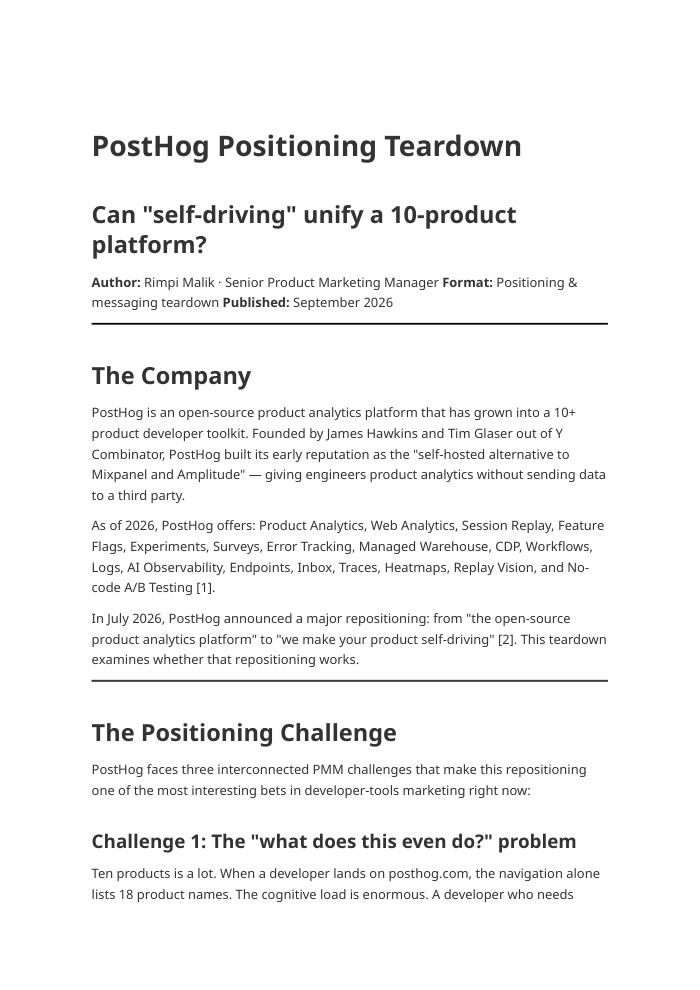
First page of the PostHog: Can
Positioning

PostHog: Can "self-driving" unify a 10-product platform?

A positioning and messaging teardown of PostHog's 2026 repositioning, from "open-source product analytics" to "we make your product self-driving."

What I found

PostHog's pricing story and developer-native voice are genuinely strong, but the "self-driving" metaphor leads with abstraction instead of concrete value, and the 18-product navigation has no hierarchy. Recommends leading the hero with mechanism before metaphor, grouping products into Understand / Test / Automate, replacing a social-proof joke with a real retention stat, and building a competitive battlecard for the sales-assisted motion (consolidation argument: one platform vs. five tools, usage-based vs. per-seat pricing).

Sources include posthog.com, the PostHog handbook, linear.app, and vercel.com for comparison.

View teardown ↗
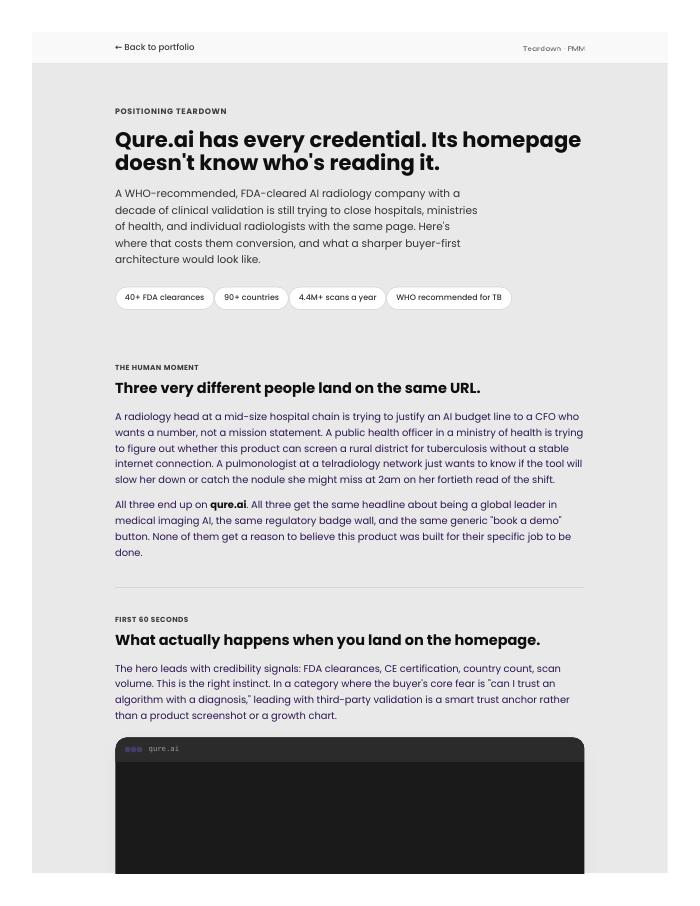
First page of the Qure.ai: AI Healthcare Positioning
Positioning · Healthtech AI

Qure.ai: AI Healthcare Positioning

Why a WHO validated AI healthcare company is leaving conversion on the table across four buyer types.

What I found

Diagnoses homepage messaging across four buyer types served by one undifferentiated page, and proposes a segmented information architecture.

View teardown ↗
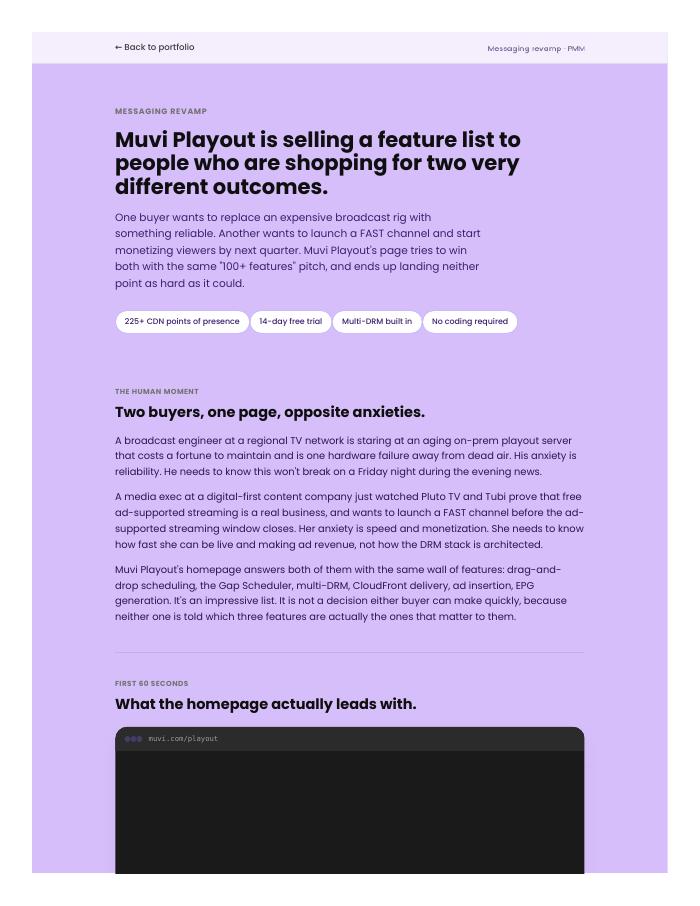
First page of the Muvi Playout: Messaging Teardown
Messaging

Muvi Playout: Messaging Teardown

Before and after messaging analysis, ICP segmentation, and a full page architecture rebuild.

What I found

Translates an invisible backend streaming infrastructure system into a buyer facing value proposition.

View teardown ↗
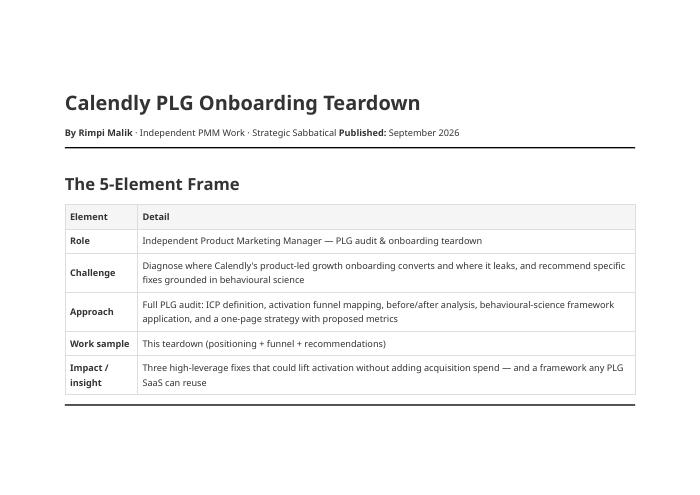
First page of the Calendly: PLG Onboarding Teardown
PLG onboarding

Calendly: PLG Onboarding Teardown

Viral loop mapping, activation cliffs, and three fixes grounded in behavioural science.

What I found

Maps the full viral loop from signup to booked meeting and proposes fixes grounded in the Zeigarnik effect and social proof.

View teardown ↗
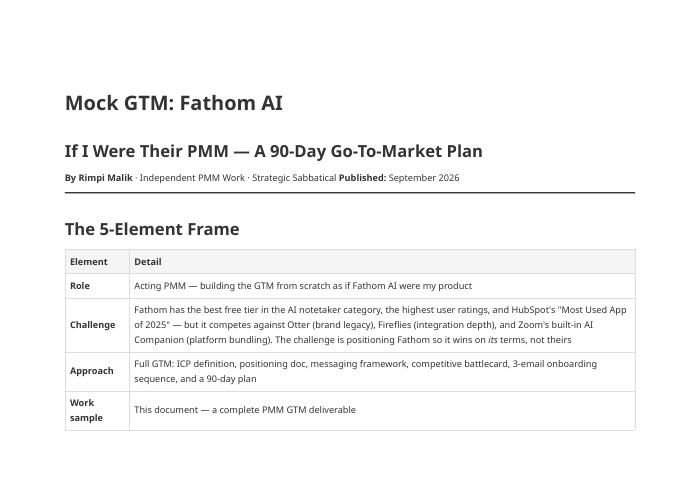
First page of the Fathom AI: Mock GTM
Go to market

Fathom AI: Mock GTM

A full 90 day go to market plan: positioning, battlecards, onboarding sequence, success metrics.

What I found

Repositions Fathom from "free AI notetaker" to "summary first, privacy respecting," with battlecards against Otter and Fireflies.

View teardown ↗
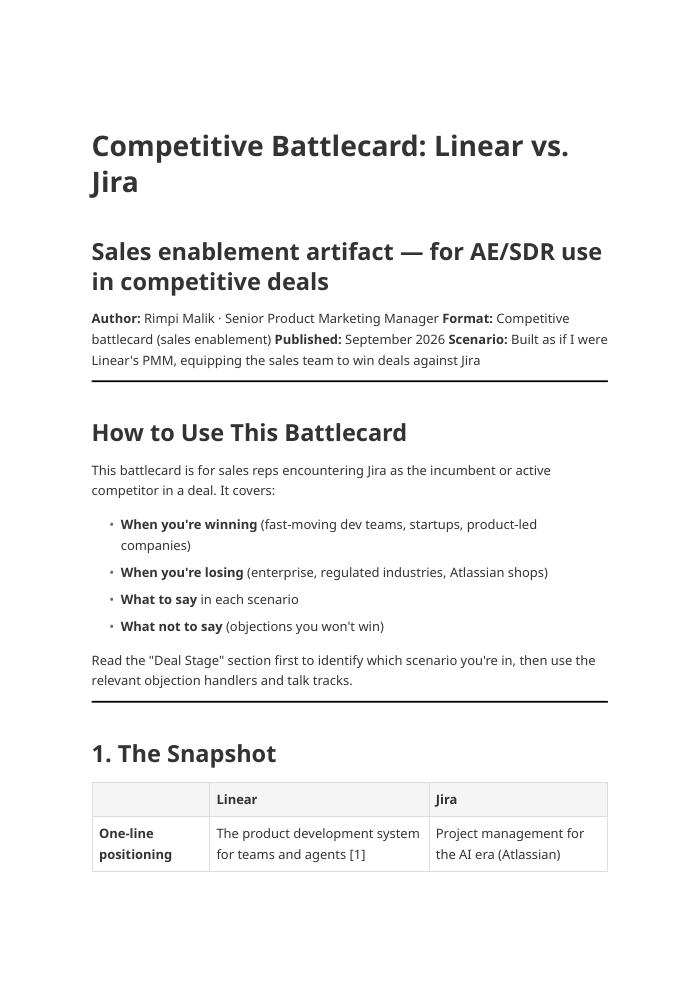
First page of the Linear vs. Jira: Competitive Battlecard
Battlecard

Linear vs. Jira: Competitive Battlecard

Built as if I were Linear's PMM, equipping sales to win deals against Jira, including when to walk away.

What I found

Maps four deal scenarios with a talk track for each, built around Linear's speed, native AI, and opinionated workflow against Jira's configurability tax. Includes objection handling, a "what not to say" table, and a post-sale migration playbook.

View teardown ↗

Other projects

Writing and research

Behavioural science library

9 essays on why people click, buy, stay and leave, each tied to a real paper and a takeaway for product marketers.

Read the essays →
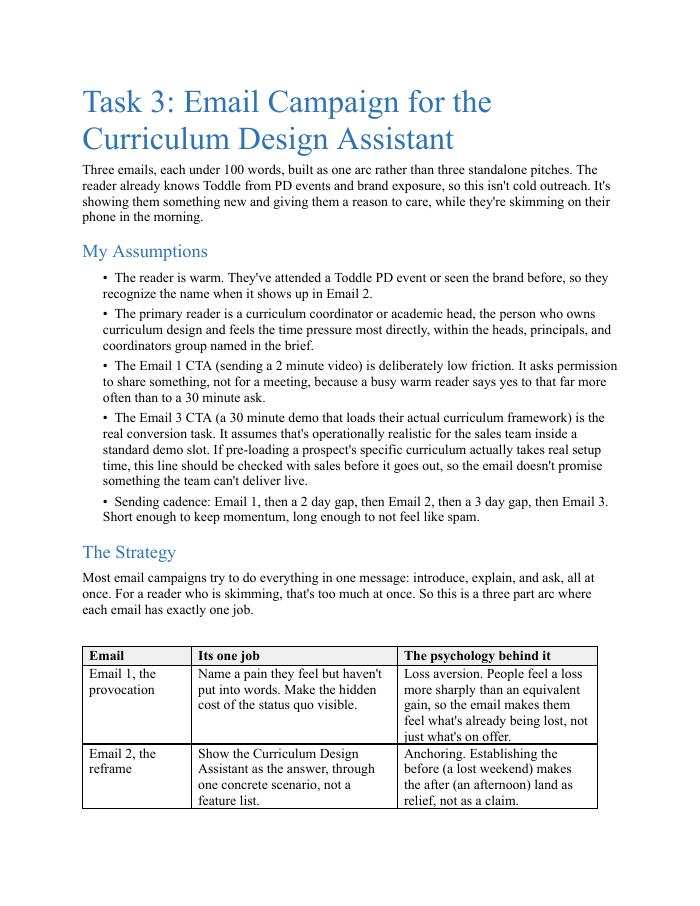
First page of the Toddle assignment
Project · Toddle Email Marketing Plan

A 3 email arc: provocation, reframe, invitation

Three emails, each under 100 words, built as one connected arc rather than three standalone pitches, grounded in loss aversion, anchoring, and cognitive ease.

Read the summary

A 3 email arc: provocation, reframe, invitation

Three emails, each under 100 words, built as one connected arc rather than three standalone pitches, grounded in loss aversion, anchoring, and cognitive ease.

The strategy

Most email campaigns try to introduce, explain, and ask all in one message. For a reader skimming on their phone, that's too much at once. So this is a three part arc where each email has exactly one job, and it only works because the audience is warm (they already know Toddle from PD events), so the job isn't to prove the brand is real, it's to show them something they haven't seen that solves a problem they actually have.

EmailIts one jobThe psychology
1. ProvocationName a pain they feel but haven't put into wordsLoss aversion
2. ReframeShow the product as the answer, through one concrete scenarioAnchoring
3. InvitationMake the next step small, specific, easy to say yes toCognitive ease

The emails

What I would test

Subject line framing (loss aversion vs. direct provocation), CTA specificity ("send a video" vs. "would it help if"), send cadence (2 day vs. 3 day gaps), and personalizing Email 2 with the recipient's actual curriculum framework. The strategy stays fixed, the execution details stay testable.

View full assignment (PDF) ↗
View full assignment ↗

More teardowns and standalone case studies are added as I finish them.

Want the full picture?

My resume has the complete role history and metrics. Happy to send it over or talk through any of this work.